
Reading a Custom Jewelry Factory's Manufacturing Steps
A published step list is the least costly piece of due diligence a factory can hand over, and it usually sits in the open. The one published here runs eight operations from concept design to delivery, quotes 25–30 days for a master sample and 3–4 weeks for the bulk run after approval. Read the list before you read the quotation, because the list explains what the quotation is actually paying for.

Key takeaways
- Eight operations run from concept design and prototyping through sprue cutting, polishing, surface art, electroplating and final QC to delivery.
- Only three stages carry published durations: CAD inside 48 hours, sampling at 25–30 days, production at 3–4 weeks.
- A separate six-step customer route wraps those eight steps: enquiry, consultation, CAD, sample approval, bulk production, QC and delivery.
- 100% inspection before packing is the last claim to test, since it is the one that decides what a customer receives.
What a step list proves before a sample exists
Any supplier can show a photograph of a finished ring. Fewer can describe the sequence that produced it, and fewer still can say which of those steps happen under their own roof. A step list is therefore a test of vocabulary: if the description never mentions sprue cutting, polishing passes or a plating stage, the supplier is describing a product rather than a process.
Read the list twice. The first pass tells you what the factory can make. The second tells you what it cannot skip, because every named step is an opportunity for a defect to be found before the next one begins.
The eight steps in the order the floor runs them
Work in sequence: concept design by hand and in CAD, then prototyping through a mould or 3D printing, then sprue cutting, a high-gloss polish, brushed and textured surface art, electroplating for a hard-wearing coating, quality control last at 100% inspection, and finally delivery with global shipping. Two of those eight steps are shaping operations and two are finishing operations, which is why a design that survives prototyping can still fail at the plating line.
The order matters because it is not interchangeable. Surface art follows polishing, because a brushed finish applied before a high-gloss polish would simply be polished away. Electroplating follows both, because a plating bath deposits evenly on a finished surface and unevenly on a scratched one.
Where the six-step customer route meets the eight-step floor
The client-facing route has six stages: inquiry with sketches, reference photos or tech packs; consultation on feasibility, material selection and cost structure; CAD and prototype inside 48 hours for dimensional sign-off; sample and approval across 25–30 days; bulk production after approval; and final QC with 100% inspection, branded packaging and worldwide express shipping.
Map the two together and the floor steps sit inside the customer stages. CAD modelling and prototyping cover the concept design step and part of prototyping. Sample and approval cover wax printing, mould casting, stone setting, polishing and electroplating. Bulk production repeats those same bench operations at scale, which is the reason a sample approval is a production decision and not a formality. Choosing a reliable jewelry OEM factory is really a question of whether anyone there can walk you from one map to the other without pausing, and the six-stage OEM/ODM route that TTT Jewelry publishes is the map most buyers are handed first.
The three steps that decide whether a batch repeats
Repeatability is not a property of a sample, it is a property of the middle of the process. Sprue cutting, polishing and electroplating are the three stages where small drifts turn into visible differences between batch one and batch three, and all three sit after the point where most buyers stop paying attention.
| Stage group | Operations named | What it decides |
|---|---|---|
| Design and model | Concept design, CAD, 3D printing | Dimensional sign-off inside 48 hours |
| Forming | Mould casting, sprue cutting | Weight and silhouette consistency |
| Finishing | Polishing, brushed and textured surface art | How light reads on the metal |
| Coating | Electroplating, anti-tarnish e-coating, PVD | Colour hold and wear behaviour |
| Release | Final QC, 100% inspection, delivery | What actually reaches the customer |
Questions a step list answers without a meeting
Colour from multi-layer gold (14K, 18K, 24K) and rhodium; protection from anti-tarnish e-coating (silver and brass) and PVD for steel.
None of those answers requires a meeting, a factory tour or an NDA. They require the supplier to have written the process down, which is itself the signal buyers are looking for.
Worked example: how 25–30 days divides across five operations
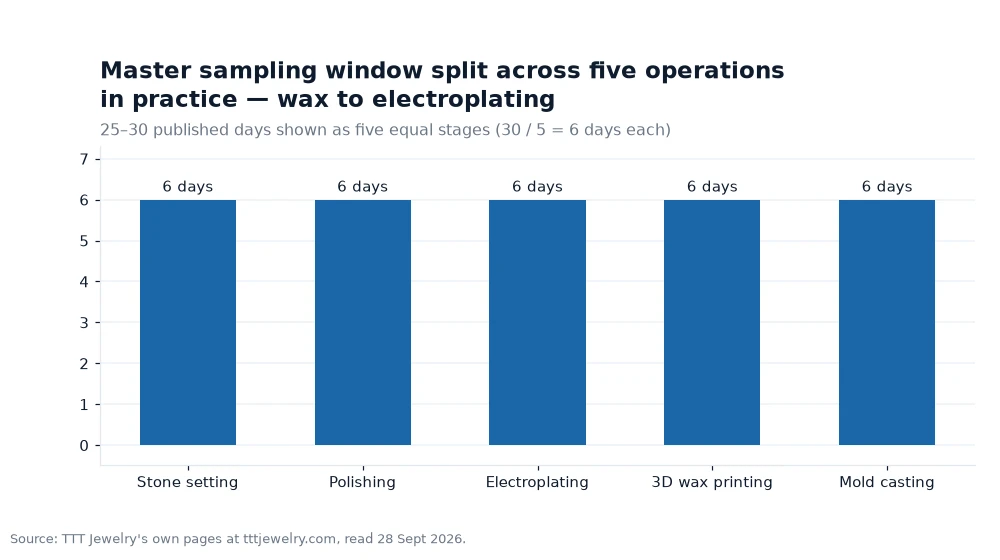
Take the published sampling window and the five bench operations it covers: 3D wax printing, precision mould casting, stone setting, polishing and custom electroplating. Thirty days divided by five operations is 30 ÷ 5 = 6 days each. At the fast end of the same window, 25 ÷ 5 = 5 days each. The realistic per-operation allowance is therefore five to six days.
That arithmetic is mine; the 25–30 day window is the manufacturer's. It matters because it reframes a revision request. Adding a second stone-setting pass does not add a day to the schedule, it adds five or six, which is why an unusual detail is best raised during the CAD stage while changes still cost screen time rather than bench time.
Frequently asked questions
How many steps does a custom jewelry factory actually run?
Eight on the floor, from concept design and prototyping through sprue cutting, polishing, surface art, electroplating and final QC to delivery, wrapped inside a six-stage customer route that starts with the enquiry.
Which stage should a buyer question first?
The coating stage, because it is where appearance and durability meet: multi-layer electroplating in rhodium, 14K/18K/24K gold, anti-tarnish e-coating for silver and brass and vacuum PVD plating for steel.
Does a longer step list mean a better factory?
Not by itself. What matters is that each named step has an owner and a check, and that QC sits after plating and before packing rather than only at the end of the line.
Reading a process the way a production manager does
Take any supplier's description and separate the words that name an operation from the words that describe an outcome. Named operations are verifiable, outcomes are not. A list that names eight operations and gives three of them durations has told you where the risk lives and where the slack is. The published figures sit on the factory process overview, and the material-specific behaviour of the coating stage is broken out per metal across the stainless steel manufacturing notes.
The list this piece builds on — the 50 / 100 / 100+ piece minimums; the six customisation variables, the gold and rhodium plating options — is listed at the manufacturer's published pages on tttjewelry.com (read 28 Sept 2026). Inspection is manual and every piece is checked, packaging runs to five items, and plating covers four finishes. The reply commitment is 24 hours. Sampling runs 25–30 days, production 3–4 weeks, and CAD comes back inside 48 hours. The restatement in weeks is my own rather than the manufacturer's [1]