
ODM Project Cost and Ownership for a Festive Gifting Range
An ODM project for a festive gifting range is not a perfume order with a box attached. The cost sits in four places, the scent itself, the primary pack, the gift presentation, and the coordination that holds a fixed ship date together, and each of those four carries an ownership question alongside its price. Brands that read cost and ownership as one document usually negotiate better terms than brands that treat ownership as a legal afterthought, because the lines that look most technical are also the lines that decide what the brand keeps when the season is over.
Key takeaways
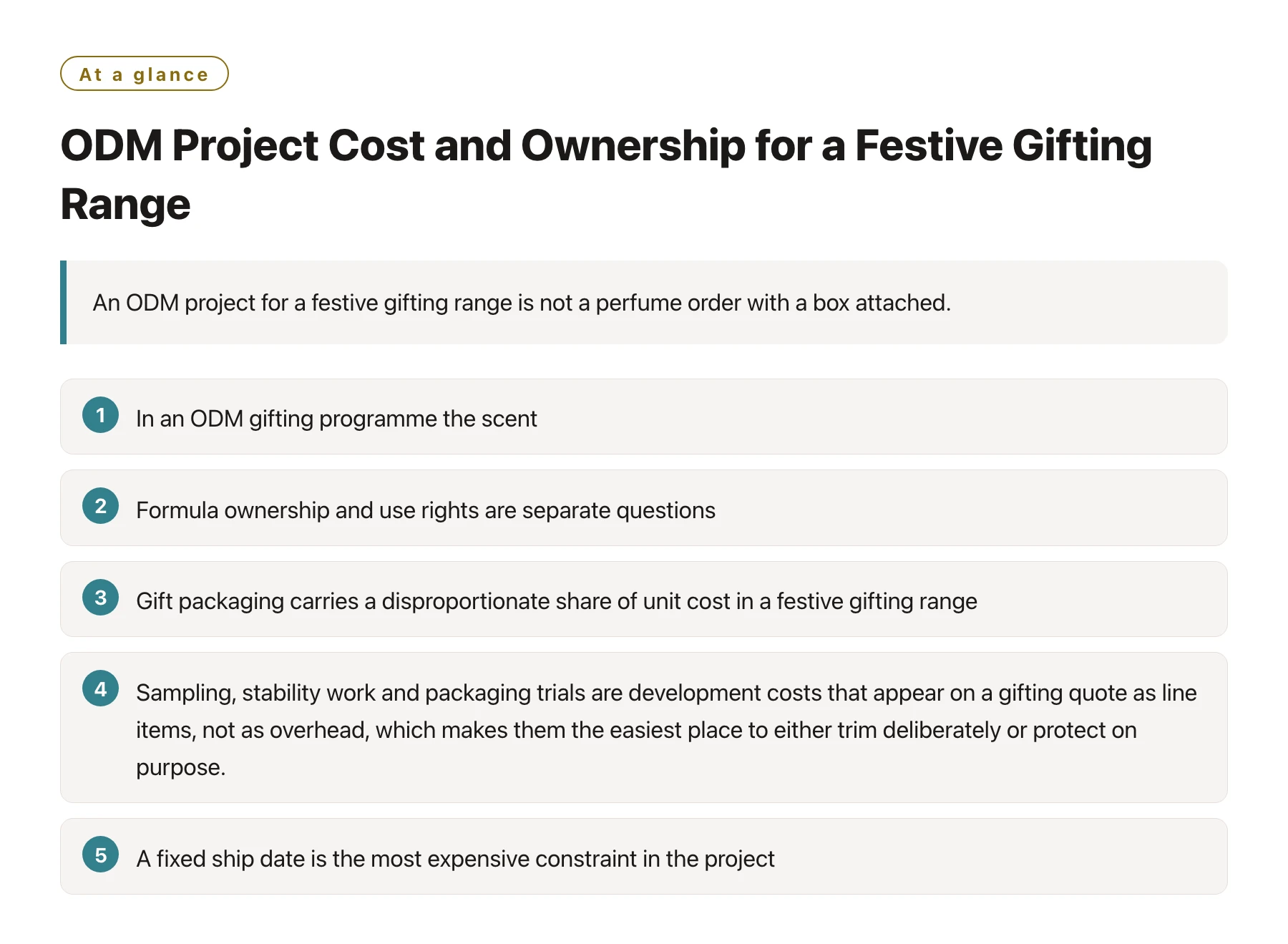
- In an ODM gifting programme the scent, the fill, the bottle and the gift box are developed together, so the quotation has to be read as one programme rather than four separate purchases.
- Formula ownership and use rights are separate questions, and a development fee does not automatically transfer the composition; the terms that govern reuse after the first order are the commercially important ones [1].
- Gift packaging carries a disproportionate share of unit cost in a festive gifting range, because decoration, inserts and the outer box are all bought inside the same short production window.
- Sampling, stability work and packaging trials are development costs that appear on a gifting quote as line items, not as overhead, which makes them the easiest place to either trim deliberately or protect on purpose.
- A fixed ship date is the most expensive constraint in the project, because compressing it shifts money into air freight, overtime and express tooling rather than reducing the work itself.
- Before signing, ask what the brand receives at handover: a formula record, a retained reference, artwork files and test results are the deliverables that make next year's reorder a purchase order instead of a new development project.
Seasonal gifting is a different commercial animal from a core fragrance line. The development calendar is shorter, the packaging carries more of the perceived value, and the whole range has to be on a shelf or in a warehouse before a date that cannot be moved. That combination is why gifting projects produce more disagreement about money than about scent.
The disagreement is usually not about the total. It is about which party pays for the parts of the project that only become visible halfway through: the second decoration trial, the insert that has to be re-cut, the stability test on a combination nobody listed at the briefing stage. A quote that prices the work but never assigns ownership of the results is incomplete rather than cheap, and the gap tends to surface at the most inconvenient moment.
What follows is a line-by-line view of an ODM gifting programme from a procurement seat, with the ownership question that sits next to each cost line, followed by the two documents that answer most of those questions.
Where the money goes in a festive gifting programme
| Cost line | What drives it | Ownership question attached |
|---|---|---|
| Scent development | How many directions the fee covers, whether the brief is library-led or built from scratch, and how many refinement rounds are included | Does the fee buy use rights, exclusive rights in a field, or assignment of the composition? |
| Concentrate and fill | Dosage and concentration, plus whether the same scent is used across several products in the range | Who holds the retained reference standard that the bulk order is compared against? |
| Primary packaging | Whether an existing mould is used or a new one is cut, and how many units the mould run has to cover | Does the brand own the mould, or only the right to order from it? |
| Decoration | Coating, print, foil or frosting, and how many passes each unit needs to reach the approved look | Who owns the print artwork and the decorated sample that was approved for production? |
| Gift presentation | Outer box, insert, sleeve, ribbon, and how much hand assembly the format requires per unit | Are packaging drawings and dielines handed over, or held by the supplier? |
| Testing and compliance | How many product and pack combinations are tested, and which markets the labelling has to satisfy | Who keeps the test reports, and can the brand obtain copies on request? |
| Logistics and schedule | The ship date, the transport mode, and how much buffer the production calendar genuinely contains | Which party carries the cost if the ship date moves, and up to what limit? |
Read as a table, the pattern is hard to miss: the lines that look most technical are also the lines that decide what the brand keeps. Putting a name against each line before the negotiation starts changes the conversation, which is why reading a perfume price breakdown first tends to produce a shorter and more productive discussion.
The ownership questions a festive gifting range makes urgent
Gifting compresses a normal development cycle into a fixed window, and the compression is what makes ownership unusually urgent. A range that sells well in December will be reordered the following year, sometimes with a different supplier if the first relationship does not survive the season. Everything that makes a reorder possible without redeveloping the scent has to be settled while the project is still friendly.
Two documents usually carry the answer. The development agreement says what the fee buys, whether that is use rights in a defined field, exclusivity in a territory, or outright assignment. The supply agreement says how the result is treated afterwards, including what happens at termination. Brands negotiate the first carefully and skim the second, which is the mistake that only becomes visible when the range succeeds.
The composition and the packaging are protected differently
Fragrance compositions and packaging design sit under different intellectual property regimes and are documented in different ways. A formula is often protected as a trade secret rather than disclosed in a filing, while a bottle silhouette or a decorative pattern is more likely to be covered by a design registration [1]. For a gifting range both matter, because the box and the bottle carry a large share of what the customer believes they are buying.
A practical test before signing is to ask which parts of the project the supplier considers proprietary, which parts are transferred to the brand, and which parts are licensed for use. A supplier that answers in those three categories is describing a position. One that answers only that everything is included is describing nothing that can be relied on later.
Packaging choices that carry cost and recyclability
Gift formats use more material than standard lines: an outer box, an insert, often a sleeve or ribbon, and frequently a decoration that cannot be separated from the bottle at end of life. Material choice is a design decision, but it is also a costing and compliance decision, because packaging rules in several markets now attach to material weight and recyclability rather than to waste targets alone [2]. Raising the question during design is considerably cheaper than re-cutting an approved insert after tooling.
None of this requires a brand to become a packaging engineer. It requires asking for the material list and the dielines early, and choosing a partner that treats them as part of the deliverable rather than as internal paperwork. An ODM partner such as Xuelei that runs development and production under one roof will normally have those documents assembled already, which is one of the quieter advantages of a single-source programme.
If the gifting budget has to be defended internally, defend it on three lines: the number of development directions included, the ownership and reuse terms attached to the formula, and the ship date with its freight assumption written next to it. Those three explain most of the difference between two quotes that look far apart, and they determine whether next year's reorder is a purchase order or a second development project. A partner offering one-stop fragrance manufacturing should be able to show how each one is handled inside the same contract.
Sources
- WIPO — World Intellectual Property Organization —— The UN agency for intellectual property; resources on industrial design and patent protection relevant to product and packaging design.
- Sustainable Packaging Coalition —— A membership organisation working on more sustainable packaging design, publishing material and recyclability guidance.
Frequently asked questions
Does an ODM gifting project cost more than building a range in separate steps?
Not necessarily more, but differently. A single-source programme prices coordination, sampling and packaging trials inside one quotation, while a split approach spreads those costs across several suppliers and adds the time needed to reconcile them. The comparison only becomes fair when both quotes list the same scope, including decoration, testing and the freight assumption behind the ship date.
Who owns the fragrance formula in an ODM project?
It depends on the contract rather than on the model. Many ODM manufacturers retain the composition and grant the brand rights to use it, sometimes exclusively within a defined market or product field. The practical questions are what happens at reorder, what happens if the brand wants a second supplier, and what happens at termination, all of which the agreement should answer in writing.
Should a brand pay for a packaging mould in a gift range?
That depends on volume and on how distinctive the pack needs to be. Using an existing mould keeps tooling out of the budget but limits the shape to what already exists. Cutting a new mould buys differentiation and usually requires the brand to understand whether it acquires the tool, holds an exclusive right to it, or simply funds its first use.
How far ahead should a festive gifting range be planned?
Far enough that sampling, decoration trials and stability work are not compressed into the production window. The calendar risk in gifting is rarely the fill itself; it is the sequence of approvals on decorated components, gift assembly and packaging, each of which consumes a fixed number of days that cannot be shortened by paying more.
What documents should a brand hold at the end of a gifting project?
At minimum a formula record or reference to the retained standard, the test reports commissioned during development, the approved decorated sample, packaging artwork and dielines, and the labelling inputs derived from the formula. Together they make the range reproducible and reduce the brand's dependence on a single relationship.
Translate this into a working deployment.
Send your bill of materials, panel sizes, target markets, and timeline. Our regional engineering desk returns a confirmed quote with stock allocation within one business day, SGT.